 Revised algorithm
Revised algorithm
Revised algorithmNow we explain how revised algorithm check the inconsistency in the previous example.
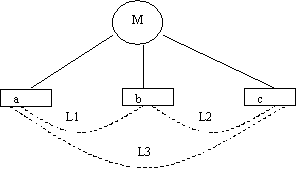
L1: a]<2 [b;
L2: b]<2 [c;
L3: c]<2 [a;
Initial value:
begin(M)=0 end(M)=2;
bgein(a)=0 end(a)=2;
bgein(b)=0 end(b)=2;
begin(c)=0 end(c)=2;
L1:
bgein(b)=4 end(b)=6;
Propagation
(now L2 and L3 are marked as '0' ,so only end(b) will be propagated to M;)
end(M)=6;
L2:
begin(c)=8 end(c)=10;
propagation
(now L3 is marked with '0',so only end(c) will be propagated to M)
end(M)=10;
L3:
begin(a)=12 end(a)=14;
propagation
S={L1,<a,M>}
path={a};
L1:
begin(b)=16 end(b)=18;
propagation
S={L2,<b,M>}
path={a,b}
L2:
begin(c)=20 end(c)=22;
propagation
S={L3,<c,M>}
path={a,b,c}
L3:
here we find a is already in Path;
and L3 will change begin(a)=24 end(a)=26 which
is original propagation condition;
So we stop here.
In fact, if keep running it will cause a dead loop.
