Transformation From Hypergraph to Time-line
Transformation From Hypergraph to Time-line
Transformation From Hypergraph to Time-line
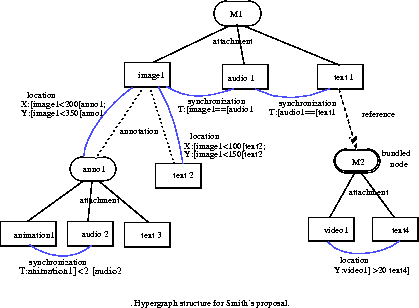
Now we illustrate the proposed algorithm by giving one example.
Synchronization links:
L1: ainimation1] <2 [audio2;
L2: [image1]==[audio1]
L3: [audio1]==[text1]
assume interval of each terminal node is 2
(if not specified);
Intitial value:
begin(M1)=0; end(M1)=2;
begin(image1)=0; end(image1)=2;
begin(audio1)=0; end(audio1)=2;
begin(text1)=0; end(text1)=2;
begin(anno1)=5; end(anno1)=5+2=7;
begin(text2)=5; end(text2)=7;
begin(animation1)=5; end(animation1)=7;
begin(audio2)=5; end(audio2)=7;
begin(text3)=5; end(text3)=7;
1) Process L1;
begin(audio2)=9; end(audio2)=11;
audio2 is connected to anno1 by attachment link, and since end(audio2) has been
changed and from rules (1),we know we need to propagate this change to anno2;
so s={<audio2,anno2>}
propagate:
end(anno1)=11;
The same thing happened here: anno2 is connected to image1 by
annotation link and change of end(anno1) will cause end(image1)
to be changed according to rules (2).So s={<anno1,image1>}
propagate:
As before,propagate of end(image1) should be propagated to M1.
end(M1)=11;
and finally, M1 doesn't cause any propagation. Although it is connected with
audio1,text1, it is in the left part of the fourth rule of rules(2).So we can
stop here.
2) Process L2:
end(audio1)=end(image1)=11;
propage through attachment from audio1 to M1;
end(M1)=11; (remain unchanged);
3) Process L3:
end(text1)=end(audio1)=11;
propage through attachment from text1 to M1;
end(M1)=11; (remain unchanged);
Finally:
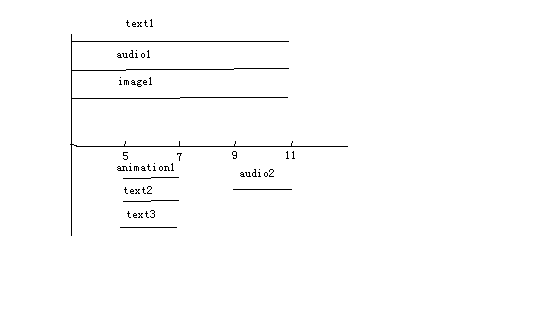
begin(M1)=0; end(M1)=11;
begin(image1)=0; end(image1)=11;
begin(audio1)=0; end(audio1)=11;
begin(text1)=0; end(text1)=11;
begin(anno1)=5; end(anno1)=11;
begin(text2)=5; end(text2)=7;
begin(animation1)=5; end(animation1)=7;
begin(audio2)=9; end(audio2)=11;
begin(text3)=5; end(text3)=7;
Time line :