
NAME: Wireless Patterns CATEGORY: Context Setting
Patterns
- CONTEXT:You are an experienced Programmer and want to make pattern in the context of wireless networks
- PROBLEM: How can you ensure that the essence of your software pattern can be understood by your entire
target audience?
- FORCES:
- A pattern can be different things to different people.
- People with different backgrounds require different amounts of detail.
- Using too much audience-specific jargon may limit the potential audience.
- Diagrams and illustrations are often more effective than prose when it comes to communicating concepts, especially those related to software design. "A picture is worth a thousand words."
- Programming languages are designed to convey software concepts in a formal, precise, and unambiguous manner.
- Too much code interrupts the pattern's flow and may make it unmanageably large.
- There is no universally understood programming language. Code Samples will be understood only by those readers who are familiar with the language you use.
- SOLUTION:
- Use terminology that is tailored to the audience.
- Include a Glossary of terms which may be unfamiliar.
- Use diagramming notations that are likely to be familiar to the target audience.
- Use a programming language likely to be understood by the Target Audience.
- Ensure that the code samples are well-commented.
- Ensure that your code samples are "ready to run".
- Ensure that the pattern can stand on its own, able to communicate its essential concepts even if the code examples were deleted.
- RATIONALE: A pattern that can be understood by the target audience is more likely to be useful. The more
widely used the notation you use, the more likely that readers will be able to understand your diagrams without the need for a bulky and
distracting explanation.
- DIAGRAM:
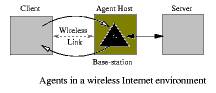
In a wireless Internet environment , the agent host would be
either near or at the base station

STANDARD:can spawn children or move off host but can communicate to
client
DEADEND: cannot
spawn children or move off host but can communicate to
client
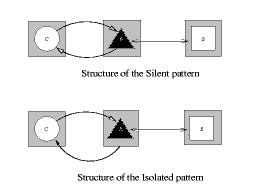
SILENT: can spawn children or move off host but cannot communicate to
client
ISOLATED: cannot spawn children or move off host but cannot communicate to
client
