
Pattern : MANDATORY ELEMENTS PRESENT
- PROBLEM : How do you make sure that all necessary information is covered in a pattern?
- CONTEXT : You are writing a pattern, either standalone or as part of a pattern language.
- FORCES :
- All patterns do not require the same kinds of information to be effectively communicated. Capturing all
elements regardless of need only clutters many patterns.
- For a pattern to be truly useful, it must have a minimum set of essential information. These information
elements are required to allow patterns to be found when required and to be applied when applicable.
- If the necessary elements are missing, it becomes much harder to determine whether the pattern solves
the reader's problem in an acceptable way.
- There is no single correct style or template for patterns; trying to impose one could stifle creativity and
get in the way of effective communication.
- SOLUTION :
Include the following Mandatory Elements in the pattern.
Figure 2: Relationships Between Pattern Elements.
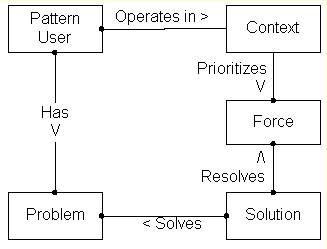
- The exact names of these elements vary from one pattern style
to another and the exact order in which they appear in is not as crucial as ensuring that they are all present.
- RATIONALE : In the many patterns that have
been written since The Timeless Way of Building [Alexander79] and A Pattern Language [Alexander77] were first published, these mandatory
elements have been found to be the minimum information required to effectively communicate a pattern.
- EXAMPLE : All the patterns in this language have Mandatory Elements Present.
